
Croatia’s Dalmatian coast is made for a week on a crewed yacht. Islands sit close together, Greek, Roman and medieval history lines the harbours, and the stretch from Split to Dubrovnik links three UNESCO World Heritage Sites with some of the Adriatic’s quietest anchorages. Here is a sample seven-night itinerary to help you plan a summer 2027 charter.
Your captain will adapt the route to the weather, your group and the yacht. Treat this as a starting point rather than a fixed timetable.
Day 1: Split and Diocletian’s Palace
Most Dalmatian charters begin in Split. The historic centre is built inside and around the palace that the Roman emperor Diocletian had built between the late 3rd and early 4th centuries AD, and it has been a UNESCO World Heritage Site since 1979. Walk the old lanes before you board: the medieval cathedral was built using material from the emperor’s mausoleum, and Romanesque churches, Gothic palaces and Renaissance and Baroque houses fill the streets around it. If you hear harmony singing in the evening, it is likely klapa, the Dalmatian a cappella tradition that UNESCO recognises as intangible cultural heritage.
Day 2: Hvar Town and the Pakleni Islands
A short cruise brings you to Hvar, the island’s busiest harbour. Climb to the Fortica, the Spanish fortress rebuilt after a gunpowder explosion in 1579, for the best view over the town and bay. Back on the square, Hvar’s theatre opened in 1612 on the first floor of the old Arsenal and is one of the oldest surviving theatres in Europe. Rather than stay in the crowded harbour overnight, most crews anchor among the Pakleni Islands just to the south. They are a protected landscape and the reason Hvar’s port is sheltered all year.
Day 3: Stari Grad and its ancient plain
On Hvar’s north coast, Stari Grad is a slower, older town. Greek settlers from the island of Paros founded it in the 4th century BC and divided the land behind it into geometric plots bounded by dry stone walls. That field pattern, the Stari Grad Plain, has survived largely intact for about 24 centuries and became a UNESCO World Heritage Site in 2008. Grapes and olives are still grown there, as they have been since Greek times, so a vineyard lunch here has a long history behind it.
Day 4: Vis and Komiža
Vis feels further from the mainland than it is. It served as a main base of the Yugoslav navy until 1989 and was closed to the public for much of that time. Two famous sea battles were fought just north of the island: in 1811, when a small British squadron under William Hoste defeated a larger French force, and in 1866, when the Austrian fleet defeated the Italians. On the west coast, the fishing town of Komiža gave its name to the falkuša, a traditional fishing boat developed there in the 16th century. Ask your crew to find a bottle of Vugava, the island’s own white grape.
Day 5: Korčula
Heading south-east, Korčula Town sits on a walled peninsula. It is known for the Moreška, a sword dance performed in the town since around the 16th century, and for Grk, a white wine produced only on the island in quantities too small to export. Local tradition also claims Marco Polo. A 16th-century account says he was captured by the Genoese at the Battle of Curzola off Korčula in 1298, though historians still disagree about this. Either way, the town makes a fine evening stop.
Day 6: Mljet National Park
Mljet is the green, quiet contrast to Hvar. The western part of the island has been a national park since 1960 and covers around 53 square kilometres, including a strip of sea around the coast. Anchor near Pomena or Polače, then swim, walk or cycle to the two saltwater lakes, Veliko jezero and Malo jezero. In the middle of the larger lake sits the small Isle of St Mary. For many guests this is the most peaceful day of the week.
Day 7: Dubrovnik
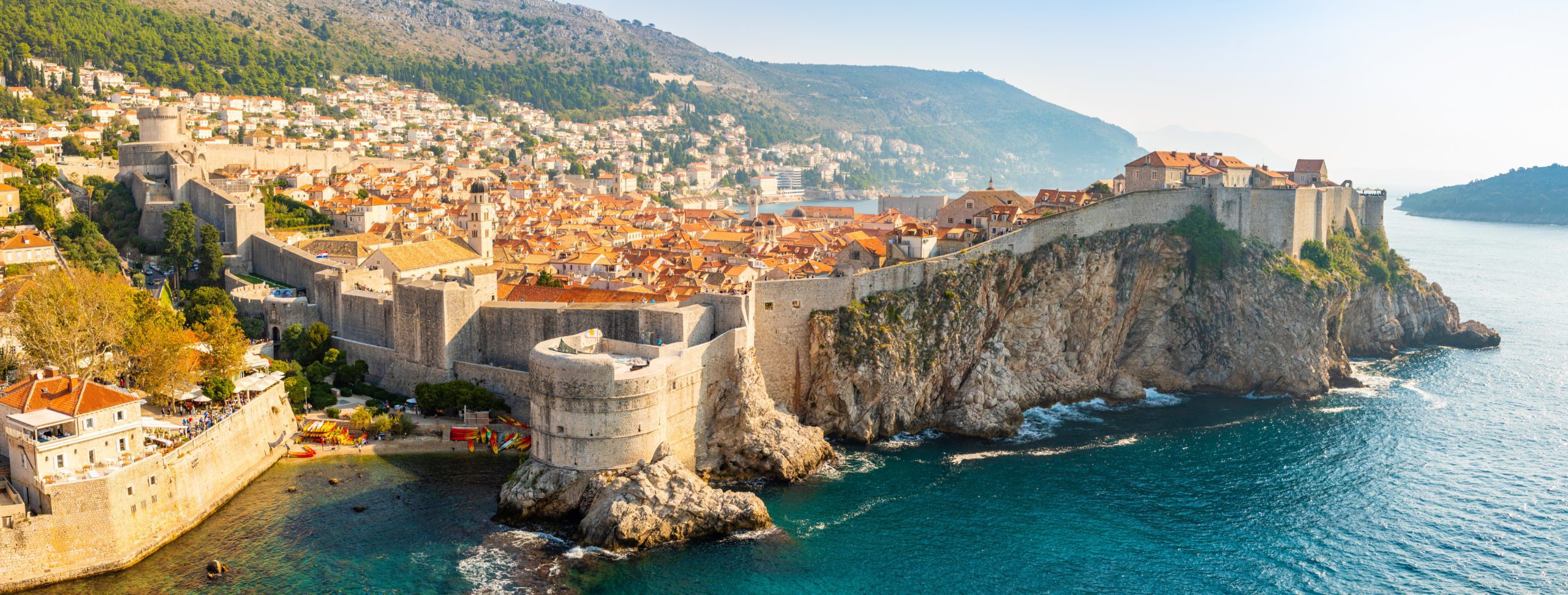
The last leg brings you to Dubrovnik, the “Pearl of the Adriatic”. From the 13th century the city was a major Mediterranean sea power, and its old town is still enclosed by medieval fortifications. Inside are Gothic, Renaissance and Baroque churches, monasteries, palaces and fountains. Much of this survived a severe earthquake in 1667 and damage during the conflict of the 1990s. The old city has been on the UNESCO World Heritage List since 1979, and a major restoration programme has followed. Disembarkation is usually the next morning, giving you a final evening on board with the walls lit up across the water.
Planning your Croatia charter
- One-way or return? A Split–Dubrovnik one-way route avoids doubling back. Some yachts charge a delivery fee to reposition, so ask about it when you compare options. Our guide to yacht charter costs, APA and VAT explains how these extras work.
- Which yacht? Catamarans suit families who want space and a stable ride at anchor. Motor yachts cover more ground if you want to add Vis and Mljet in the same week. Sailing yachts and gulets give a slower, more traditional experience.
- Book early for summer 2027. The best crewed yachts for July and August weeks are often reserved months ahead, and early-booking offers from owners usually close well before the season.
- Combine regions. If you have more than a week, you can pair Croatia with another region. For a central Mediterranean alternative, see our Malta to Sicily and the Aeolian Islands itinerary, or explore yacht charter in Greece.
Plan your week in Croatia
Tell us your dates, the size of your group and what you would like from the week: culture, swimming, food and wine, or a mix of all three. We will send you a shortlist of crewed yachts that fit. Contact iBoat International to start planning your 2027 Croatia charter.
Want this week in Croatia?
Send us your dates and group size and we will come back with available crewed yachts for summer 2027.
Get a shortlist on WhatsAppHow charter costs work
[…] Croatia: Split to Dubrovnik through Hvar, Vis, Korčula and Mljet. See our Croatia itinerary. […]